

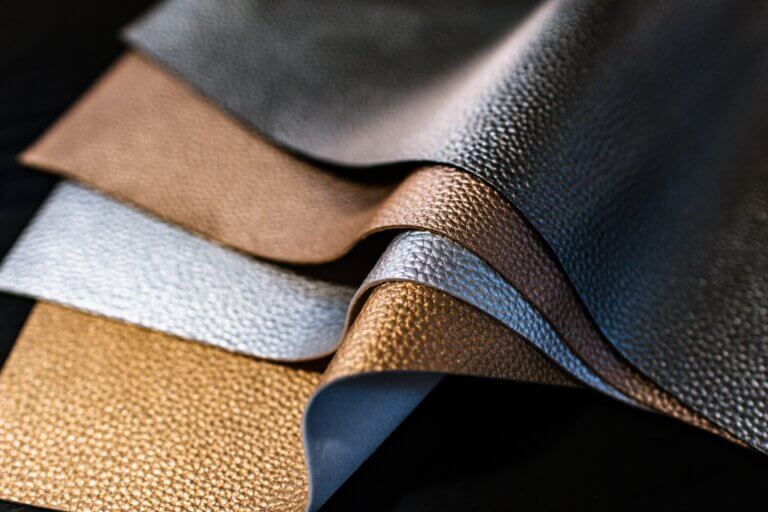
A beautiful leather garment is, above all, made of good, high-quality leather.
There are many types of leather, tanning methods (mineral or vegetable), and just as many finishes. All these unique characteristics consequently lead to different names for this noble natural material.
Let's look at the leather finishes you'll find in our collections:
- "Nappa" leather
- Washed leather
- Aniline leather
- Vegetable-tanned leather.
WHAT IS NAPPA LEATHER?
Nappa leather is full-grain leather. This leather is surface-treated and pigmented to achieve a supple, smooth, and unified finish. It is this treatment that evens out the grain.
This nappa finish applies to all types of animal skins such as lamb, calf, sheep, or goat, regardless of the tanning type, whether mineral or vegetable. Nappa leather is the most common.
It is a high-end, very good quality leather suitable for all types of uses such as clothing, automotive upholstery, shoes, or leather goods.
TIP FOR RECOGNIZING NAPPA LEATHER
Nappa leather is a term that encompasses smooth leathers. It is distinguished by its smooth appearance, without varnish, coatings, or grain. To the touch, nappa leather is very supple and delicate.
WHAT ARE THE ADVANTAGES AND DISADVANTAGES OF NAPPA LEATHER?
Nappa leather is supple but equally resistant. A protective surface treatment is applied by immersion to the skins to allow them to resist sun and bad weather. By definition, nappa leather is of great finesse. It is therefore more sensitive and vulnerable to stains and the passage of time. It tends to lighten over time. To keep it intact for as long as possible, it should be maintained approximately twice a year.
HOW TO CARE FOR NAPPA LEATHER?
Leather is a natural material and does not require daily maintenance. However, it is essential to nourish nappa leather at the beginning of each season with a nourishing milk to maintain its suppleness, shine, and color. In this way, it will gain resistance over time and wear. Without regular maintenance, leather tends to harden or even crack, like your skin.
In case of rain:
– Let your garment dry away from any heat source such as a stove or radiator. This could deform or dry it out.
– Once the garment is dry, apply a waterproofing spray (spray from 30cm away from the garment).
If you get a grease stain:
– Apply Sommières clay to the stain. It is a natural and very absorbent clay.
– Gently rub with a soft cloth or with your finger over the stain, leaving some clay on it.
– Let it act for a few hours (all night, for example).
– Gently rub or brush to remove the clay.
If your leather gets a crease:
You can easily iron your garment with a warm iron, right side out, but always with a dry and clean cotton pressing cloth between the iron and the leather.
Every 2 to 3 years, it is advisable to have your garment degreased in a specialized shop to restore its shine and unify its color (cleaning, re-pigmentation, waterproofing, etc.)
WHAT IS WASHED LEATHER?
The washed finish is mainly applied to lambskin. The skins are immersed in a chemical solution that slightly shrinks the leather. The surface of the leather is then polished and crinkled.
TIP FOR RECOGNIZING WASHED LEATHER
Washed leather is distinguished by its slightly faded and sometimes wrinkled appearance. Unlike nappa leather, it is much less smooth. It can be described as having a somewhat "vintage" look.
WHAT ARE THE ADVANTAGES AND DISADVANTAGES OF WASHED LEATHER?
The patina of washed leather will deepen over time and evolve into a unique skin. It improves with age. This leather requires little maintenance unlike nappa-finished leather. It is slightly stiffer during the first wears due to its initial chemical treatments.
HOW TO CARE FOR WASHED LEATHER?
Unlike nappa-finished leather, washed leather does not require the application of a nourishing milk. On the contrary, the use of a nourishing milk could irreversibly damage your washed leather.
In case of rain:
– Let your garment dry away from any heat source such as a stove or radiator. This could deform or dry it out.
– Once the garment is dry, apply a waterproofing spray (spray from 30cm away from the garment).
If you get a grease stain:
– Apply Sommières clay to the stain. It is a very absorbent clay.
– Gently rub with a soft cloth or with your finger over the stain, leaving some clay on it.
– Let it act for a few hours (all night, for example).
– Gently rub or brush to remove the clay.
Every 2 to 3 years, it is advisable to have your garment degreased in a specialized shop to restore its shine and unify its color (cleaning, re-pigmentation, waterproofing, etc.)
WHAT IS VEGETABLE-TANNED LEATHER?
Vegetable leather is a shortcut referring to leathers tanned with vegetable agents. Vegetable leather is indeed derived from an animal (sheep, calf, cowhide, or goat). However, the skin has been processed with vegetable tanning agents (barks, wood, roots, or leaves) as opposed to mineral tanning. This tanning process is longer and more expensive. The vegetable finish will be ready within a timeframe varying between 10 days and 8 weeks, whereas leather from mineral tanning will be ready in 24 hours. Vegetable tanning accounts for approximately 10 to 15% of production, while mineral tanning currently represents nearly 80% to 85% of global leather production.
TIP FOR RECOGNIZING VEGETABLE-TANNED LEATHER
Leather from vegetable tanning may have a slight scent of undergrowth. It is stiffer, firmer, and stronger. Vegetable leather also has natural shades, a brown appearance that darkens in light.
WHAT ARE THE ADVANTAGES AND DISADVANTAGES OF VEGETABLE-TANNED LEATHER?
Vegetable leather is highly appreciated for its natural appeal and authenticity. Each skin will be unique and benefit from minimal chemical treatment. Its innocuous and hypoallergenic qualities are undeniable for both manufacturers and customers. Highly valued in their natural colors, it is however more delicate to dye them in bright colors. Vegetable-tanned leathers are more fragile to stains and scratches.
HOW TO CARE FOR VEGETABLE-TANNED LEATHER?
Vegetable leather will not tolerate conventional care products. The application of a nourishing milk, for example, can cause stains or halos to appear on your leather.
It is therefore preferable to apply only a waterproofing spray every six months, or after rain, to your dry vegetable-tanned leather garment.
In case of rain:
– Let your garment dry away from any heat source such as a stove or radiator. This could deform or dry it out.
– Once the garment is dry, apply a waterproofing spray (spray from 30cm away from the garment).
If you get a grease stain:
– Apply Sommières clay to the stain. It is a very absorbent clay.
– Gently rub with a soft cloth or with your finger over the stain, leaving some clay on it.
– Let it act for a few hours (all night, for example).
– Gently rub or brush to remove the clay.
Every 2 to 3 years, it is advisable to have your garment degreased in a specialized shop to restore its shine and unify its color (cleaning, re-pigmentation, waterproofing, etc.)
WHAT IS ANILINE LEATHER?
Unlike nappa leather or washed leather, aniline leather is almost unadorned leather. Its color is obtained by full-bath dyeing, meaning the skin is "immersed" in a bath of dyes. No other additional finish is added, preventing the leather from breathing or developing a patina.
This aniline finish applies to different types of animal skins such as lamb, calf, or kidskin.
TIP FOR RECOGNIZING ANILINE LEATHER
Only the finest skins can undergo this treatment. Thus, aniline leather has a very natural appearance, both visually and to the touch. Aniline leather is also soft, supple, and silky.
WHAT ARE THE ADVANTAGES AND DISADVANTAGES OF ANILINE LEATHER?
Aniline leather is colored but unprotected. It is therefore much more fragile than nappa or washed leather, which have an additional protective layer. Aniline leathers are the most beautiful but also the most precious. Only the finest skins can undergo this treatment. These leathers therefore have very few or no defects. Any small skin imperfections may remain visible due to immersion dyeing. A direct consequence of the skin's fragility, maintenance will be more delicate.
HOW TO CARE FOR ANILINE LEATHER?
Aniline leather will require the utmost attention in terms of care as it does not have a protective layer.
It will not tolerate conventional care products. The application of a nourishing milk, for example, can cause stains or halos to appear on your leather.
It is therefore preferable to apply only a waterproofing spray every six months, or after rain, to your dry vegetable-tanned leather garment.
In case of rain:
– Let your garment dry away from any heat source such as a stove or radiator. This could deform or dry it out.
– Once the garment is dry, apply a waterproofing spray (spray from 30cm away from the garment).
If you get a grease stain:
– Apply Sommières clay to the stain. It is a very absorbent clay.
– Gently rub with a soft cloth or with your finger over the stain, leaving some clay on it.
– Let it act for a few hours (all night, for example).
– Gently rub or brush to remove the clay.
Every 2 to 3 years, it is advisable to have your garment degreased in a specialized shop to restore its shine and unify its color (cleaning, re-pigmentation, waterproofing, etc.)
SOME EXTRA TIPS
Grain: the upper part of the skin, the most noble part where the animal's hair follicle is located
Split: the lower part of the skin, the least noble part
Full-grain (leather): leather that has retained the full thickness of its grain
Tanning: the process of transforming skin into leather by fixing tanning agents.
Vegetable tanning: tanning carried out with tannins extracted from plants
Mineral / chrome tanning: versatile tanning carried out using chromium salts
*Definition from CTC, the French National Leather Council


